

Each year in college hockey, the NCAA crowns a national champion. But it’s rare in hockey at any level that a team garners consideration as one of the best of all-time.
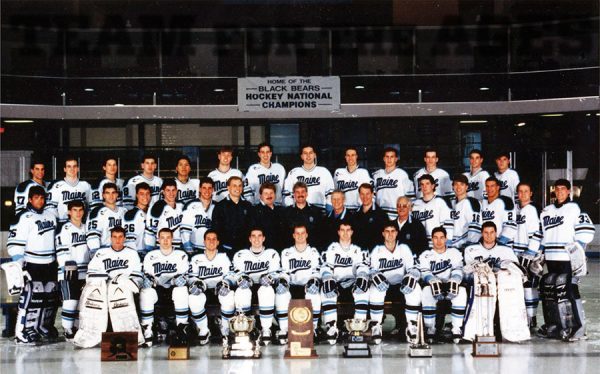
The 1992-93 University of Maine Black Bears are one of those special teams.
This month marks the 25th anniversary of the hockey program’s first national title, won by a team that went 42-1-2 and gave the university, the city of Orono and the state of Maine a moment in time that has never been forgotten.
It was perhaps the most complete team from top to bottom in college hockey history. But the success went far beyond sheer talent. The Black Bears were a close group of players who combined their talent with preparation, leadership and accountability to become champions.
From the way the coaching staff motivated players, to that season’s senior class and how a freshman like future Hockey Hall of Famer Paul Kariya carried himself on and off the ice, the 1992-93 Maine team was all about winning.
It was a culture that captain Jim Montgomery and his senior teammates quickly became immersed in after they arrived on campus as freshmen before the start of the 1989-90 season.
"They had been to two Frozen Fours when I arrived, but it was young in Maine’s dominance," said Montgomery, now the head coach at the University of Denver. "But just being around a culture where excellence was demanded and players were held accountable every practice to be prepared, it really prepared you for pro hockey."
The Black Bears had a strong core but approached the game in a way that made an immediate impact on Montgomery and his teammates.
"You learned what Maine hockey was," Montgomery said. "It was about being ready and being ready with effort and execution every day. It didn’t matter if it was upperclassmen that were defensemen like Claudio Scremin or forwards like Scott Pellerin and (Martin) Robitaille and (Guy) Perron. You learned from all these guys because they competed so hard that if you weren’t ready to practice, you never touched the puck."
Maine’s hockey culture developed quickly after Shawn Walsh was named the second head coach in the program’s then seven-year history in 1984. When Walsh took over for Jack Semler, he inherited a program that had posted a combined 27-65 record in the previous three seasons.
But by the 1986-87 season, Walsh and the Black Bears had begun their rise up the college hockey ranks, posting the program’s first 20-win season as a member of Hockey East before the first of five straight seasons of 30-plus wins leading up to the 1992-93 season.
Walsh established a strong reputation as being a gifted motivator and left a lasting impact on his players because of his preparation — a trait he instilled in them as college kids and that carried into their lives on and off the ice.
"I was incredibly impressed with his organization and diligence and attention to detail," said Kent Salfi, a senior forward on that 1992-93 Maine team. "He was able to motivate but he was also incredibly organized; he was a great tactician and he was incredibly diligent as far as implementing those tactics."
But it wasn’t just Walsh’s ability to motivate that left a lasting impact on his players. It was also the way he delivered his messages that made the difference.
"Shawn Walsh is the best communicator I have ever been around," Montgomery said. "How he was able to get everyone to raise their level of play was something that stayed with me forever."
Walsh added perhaps the most important piece of Maine’s hockey program in 1988, when he hired Grant Standbrook as an assistant coach and recruiting coordinator.
It was Standbrook who would discover some of the best talent in college hockey and become a trusted mentor to hundreds of recruits as they grew as players and people in and out of the rink under his guidance.
"He was such an excellent recruiter. He talked so intelligently about the game of hockey and also about my personal game," Montgomery said of Standbrook, who recruited him when he was playing Junior A hockey in Ontario. "The biggest thing he did is I knew he believed in me and he gave me confidence."
In 21 years at Maine, Standbrook would help assemble the pieces of two national championship teams (1993 and 1999), and his recruiting classes won five Hockey East championships and advanced to 11 Frozen Four tournaments. In 2017, the school inducted him into the University of Maine’s Sports Hall of Fame, where he joined Walsh, a posthumous inductee in 2002.
Under Walsh’s leadership, the Black Bears earned back-to-back Frozen Four berths in the 1987-88 and 1988-89 seasons and expectations quickly grew from being a competitive program year to year to having their sights set on winning a national title. Then, before the 1990-91 season, Walsh added Red Gendron as an assistant, rounding out his coaching staff.
During the 1991-92 season, the Black Bears captured the Hockey East title and entered the NCAA tournament as the top seed in the East Regional. There was a feeling throughout Orono and the college hockey world that the time was then for Maine’s first national championship.
But after a first-round bye in the East Regional quarterfinals, Maine lost, 3-2, to the fifth-seeded Michigan State Spartans in the East Regional semifinals. It was a loss that left a major mark on the program and the Black Bears’ fan base, but also one that helped to further motivate returning players, who felt like they were building toward their ultimate goal.
"The effect the loss had on us as a program is we had eight seniors coming back, and that hunger in our belly drove us," Montgomery said. "As a program, we learned how to handle expectations better the next year."
The single-elimination style of the NCAA tournament put an emphasis on playing a team’s best game each night, and it was a lesson that Salfi and his teammates really took to heart.
"(The loss) made us realize what we already knew, that a one-game shot is really difficult and you just have to get it right," Salfi said. "It’s very difficult to win, no matter how good you are."
That 1991-92 Black Bears team had posted a 31-4-2 record and two of the top three scorers were seniors — Hobey Baker Memorial Award winner Scott Pellerin and the program’s all-time leading goal scorer, Jean Yves-Roy.
For most teams in college hockey, losing that sort of offensive firepower would mean taking a step back the following year. But the 1992-93 Black Bears combined the talent and experience of the upperclassmen with the addition of a freshman class that included Kariya and the Ferraro twins, Peter and Chris.
"We had a lot higher expectations for that year," junior forward Cal Ingraham (Georgetown, Mass.) said about the disappointment of the ending to the 1991-92 season. "It was expected really at that time there that we were going to be super competitive. That was our goal (to win a national championship). With the freshman class that we had come in (the next season), it obviously ramped up expectations."
"Those freshmen gave us the confidence that we could do it," Montgomery said. "It was by far the most gifted offensive team that we’d had at Maine, and that, combined with the work ethic that was a staple of Maine hockey … we had a lot of confidence, and because of that confidence, I think that we took our game to another level. The selflessness of that team was incredible. No one cared about goals and points. We cared about being a dominant team."
But every great team has great leaders, and between the coaching staff and that year’s senior class, the Black Bears had no shortage of it.
Before the 1992-93 season, Walsh did something he hadn’t done before since he became the head coach at Maine — he chose one captain, Montgomery, to lead his team.
"It started in the spring. He told me that he wanted me to be the first lone captain in his career there," Montgomery said, "to only wear the ‘C’ and have the other players wear the ‘A’s’ and that I was the unanimous choice by all the players in the dressing room."
It was an honor that Montgomery seemed to be destined for from the time his college hockey career began at Maine.
"It was clear that Jimmy was a leader as a freshman," said Salfi. "He had leadership qualities, and being as good a player as he was didn’t hurt. He was a very, very important person on that team."
Wearing the ‘C’ also helped to drive Montgomery as the leader of a team with its focus set on winning a national title.
"That gave me the confidence to want to run the dressing room the way I wanted to. I wanted everyone to think about winning a national championship," Montgomery said. "What I mean by that is that I wanted everyone to think about the team and be selfless. We were going to hold players in the room accountable if anyone took long shifts or selfish penalties. I think we laid the ground work right from the beginning with the rest of my senior class, and I think the rest of the players rallied around it."
Looking back on it, Salfi sees Montgomery as the example of what it meant to be a member of that 1992-93 Black Bears team.
"He was kind of the personification of what that team was — we were businesslike," Salfi said. "We were a pro team playing college, that’s the way it was approached. We were amateurs that didn’t get paid but you wouldn’t have known it by the way that we approached it. We showed up to work every day and whether it was on the ice or in the weight room, whatever we were doing in the video sessions, we were business-like, and that was his mentality."
But Montgomery and his teammates also knew how to have fun, and the camaraderie of that team was perhaps one of its underrated strengths.
"We were a really tight group and we did everything together," Salfi said. "That was an interesting team because that was just so tight top to bottom. It was strange; you don’t realize it when you are there. Then you can see it (later). I have been on winning teams and I have been on losing teams at the pro level and you see it’s a lot different than it was (at Maine). It was just a great bunch of guys … we won a lot of games and had a ton of fun."
They spent a lot of time together on and off campus, exploring cities on road trips and having team dinners.
"We cared a lot about each other and did everything as a group, whether it was on or off the ice," Ingraham said.
It was a team whose cohesiveness and talent made it nearly unstoppable in college hockey that year.
After going 1-0-1 to start the 1992-93 season, the Black Bears went on a 30-game unbeaten streak, with their only tie coming in the team’s 23rd game of the season against Clarkson.
During the early part of the season, college hockey also got its first look at Kariya, who would become the first freshman to win the Hobey Baker. He played on the team’s top scoring line with Montgomery and Ingraham — a unit that finished 1-2-3 in scoring and combined for 280 points.
Kariya might have been in his first year of college hockey, but he played at a level that his teammates had never seen before. "The thing about Paul is, you watch superstars in the NHL and you are like, ‘Well how good are they?’ When Paul Kariya got on the ice, you realized how good they were, because he was clearly heads and shoulders above anyone I had ever been on the ice with and you just learned from him every day," Montgomery said.
Ingraham scored a team-record 46 goals that season and had a rule he stuck to when he played with Kariya. "Find a spot to get open and be ready, because you knew it was coming," Ingraham said.
"The vision he had on the ice was second to none compared to the guys that we were playing against and anybody that I’ve ever played with."
As the center of that line, Montgomery played the sort of style that complemented his linemates.
"Jimmy was so smart and had good speed," Ingraham said of Montgomery. "The IQ of those two was off the charts as far as hockey sense goes … you knew you were going to get your chances playing with them and you had to take advantage of it."
But scoring for the Black Bears came from all parts of the roster, and they won as a team. Together, they combined for 293 goals, and behind the primary goaltending tandem of future NHL players Mike Dunham and Garth Snow (Wrentham, Mass.), gave up just 108 goals.
Maine’s only loss came against Boston University in a game the Black Bears were leading by four goals entering the third period before the Terriers tied it and beat them in overtime, 7-6.
"It’s not how hard you fall, it’s how quick you get back up," Walsh said in the locker room after the game. It was the kind of motivational comment that helped his players put that loss in perspective and prepared them to make their push toward winning a national title.
"He kept pushing us to be great and that was his biggest thing as a motivator, was he kept finding ways to challenge us," Montgomery said. "He was pushing most of the time and when we lost, I felt he pulled away and let us seniors take over the room. I felt that when that happened and then he started pushing again, we were all pushing together."
Maine answered in a rematch with BU one night later, beating the Terriers, 6-1, to capture a second straight Hockey East regular-season title. The Black Bears went on to outscore opponents by a 53-19 margin over the next eight games to win the Hockey East championship and earn a first-round bye in the East Regional quarterfinals of the NCAA tournament.
Against the University of Minnesota in the East Regional semis, the Black Bears accomplished a first for the program in a 6-2 victory — winning a road game in the NCAA tournament.
It gave Maine its third trip to the Frozen Four in the past six seasons — the last opportunity for that year’s seniors to win it all.
"The senior class shared it with the other teammates, the urgency needed to win a national championship," Montgomery said. "There is no more waiting for the next shift. We had learned from our previous failures, especially the Michigan State failure the year before, that we don’t want to leave anything behind and that urgency was the thing and that will to win had to be there right from the start of the game."
But the Black Bears were forced to overcome adversity along the way.
In their semifinal matchup against the Michigan Wolverines, they fell behind by two goals before tying it in the second period. After going down 3-2 in the third, Patrice Tardif scored a goal that was called off by the referee, who didn’t see the net tilt forward on the play. The Black Bears responded minutes later, forcing the game into overtime. Junior defenseman Lee Saunders scored the game-winner to send Maine to its first national title game.
"It was euphoric because it was the first time the University of Maine had won after three failures in the last six years in Frozen Fours," Montgomery said. "I give Paul Kariya credit because he hadn’t experienced failure like the rest of us had and we were really relishing in that victory and he right away said, ‘Hey, we haven’t won anything yet.’ And he said it to me, and that’s when I kind of gathered myself and said, ‘OK, we’ve got to calm down here’ because we were going from such an emotional high and within 36 hours, we were going to be playing for a national championship."
Two days later, on April 3, 1993, the Black Bears faced Lake Superior State for the national title. They took a 2-1 lead into the second period but the Lakers scored three unanswered goals in the middle frame to take a 4-2 lead into the third. Between periods, Walsh and Montgomery spoke to the team to deliver a meaningful message.
"The thing that sticks out the most to me about that game was in between periods when Shawn talked to us and told us to keep going and that we were going to take care of business," Ingraham said. "Right before we were going onto the ice, Jimmy talked to us and said, ‘We are going to win this game’ and for him to go out there in the third period and score three goals to win that game was almost Mark Messier-like. He was so confident and he instilled that in all of us."
Kariya assisted each of Montgomery’s three third-period goals, and Maine held the Lakers off the board in the final 10 minutes of regulation to preserve a 4-3 victory and deliver Maine its first national championship.
Back in Orono, students and fans across the state began the celebration they’d been waiting to have for years.
"It was unreal. It was like the state championship," Montgomery said, reflecting on the reaction he and his teammates received when they returned home. "We landed and from the airport, which is probably about a 15-mile drive to campus, there were people lined up across every overpass of the highway with signs. There were lines outside the Alfond Arena trying to get in and the noise and how packed it was inside Alfond when we walked in still to this day is an incredible memory."