


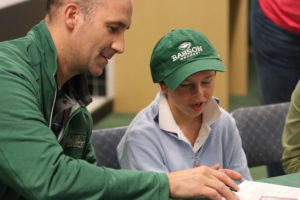
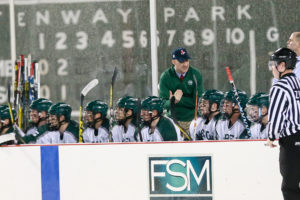
New England Hockey Journal caught up recently with Newton, Mass., native Jamie Rice, head coach of the Babson College Beavers.
A 1990 graduate of Babson, Rice was the ECAC East and New England Hockey Writers Association Coach of the Year in 2014. Rice has coaching experience at Colby College, Dartmouth, Brown and Northeastern and is a well-respected lecturer for USA Hockey’s Coaching Education Program.
Here are some of the highlights from Billy Jaffe’s chat with one of the most respected coaches in Division 3 hockey.
Billy Jaffe: You’ve been here since 2004. There’s a lot of obvious factors for “Why Babson?” But beyond “Why Babson?” what is it about the school, the environment, that works so right for you?
Jamie Rice: We get a chance to deal with the best of the best. The kids are exceptional students. They’re highly motivated, they’re driven, they want to succeed, they see the big picture and they happen to want to play a high level of hockey. … They can get a great education that can help them in the 40, 50 years after they graduate, and here as a hockey player, hopefully can have a great experience with a chance to pursue championships, play hockey at a high level and make some lifelong friends.
Jaffe: Does the D-3 level of hockey get enough respect for what it is?
Rice: Probably not, but not because people are disrespectful of us. There’s a lot of hockey in this area, so we are immediately going to fall under the Bruins, the Providence Bruins, the incredible Division 1 programs that are winning national titles … There are only about a thousand freshmen playing college hockey every year, so just to make it to any level, Division 3 or Division 1 college hockey, you’re a really good player. We are the fortunate byproduct of the explosion of hockey. Not this year but the previous three years, our captains were from Ohio, Virginia, Florida and North Carolina. That was unheard of 25 years ago. … I don’t think we’re underappreciated, but we’re under the radar. It’s really good hockey. There are a number of kids from our league who have gone on to play in Europe and in North America, who have gone on to play in levels from the NHL down to the Southern Professional. They are playing professional hockey and some of them are taking jobs from kids who played at Division 1.
 Jaffe: One of the big things in the last decade or so that has happened is the proliferation of junior leagues. Except for the exceptional status players, everybody goes at least one if not two years of juniors. How much have you seen that trickle into the D-3 level, and is that a good thing?
Rice: We’re a little bit of an anomaly, as eight of our 12 freshmen came right out of high school last year. There are a lot of good players everywhere. The real challenge is you need to find your path. High school to prep school may be right for one kid. U-18 like the Boston Advantage with Tim Lovell, Joe Lovell, that might be the right path. Maybe your high school doesn’t support hockey or you don’t have your own rink or you don’t have the right times, but you still want to be at your high school. So you play U-18 or play Midget hockey. Maybe you are at a school where you can’t get the same hockey experience that you want and there isn’t the Midget option available for you so you wind up on the junior track. Maybe your family says, “We want you to pursue it but we want you to take the educational route” and you go to prep school. I think it’s hard to cookie cutter everybody and say, “This is the path.” We’re fortunate to have so many paths. Sometimes it’s convoluted, sometimes there’s too many ingredients in the soup, but really for each family and kid, it’s what is the best path for our son to reach their potential as a person, as a student, as an athlete, because the majority of all college hockey players are going to be doing stuff outside of hockey for the remainder of their lives.
Jaffe: Is youth hockey, specifically, in a good place, and if not, where does it need to be better?
Rice: I think it’s in a great place because there’s more opportunity, there’s more rinks, there’s more teams than ever. So kids who want to play hockey can find a place to play. ... If I was czar for a day at Mass Hockey or USA Hockey, and we didn’t live in a capitalistic society, I would say, you’d play for your hometown team until you were 14, until it was starting to develop what type of player are you really. What type of potential do you have? Then at 14, if you wanted to veer off and play for whatever select or elite program, then you would have that opportunity, because then you’ve kind of established a foundation academically, because you’re not traveling all over, hopefully you are commuting to the local rink. Hopefully you have developed some incredible friendships which will be with you the rest of your life. You’ve learned the game, you’ve played hockey. You’ve probably won and lost. Whereas there are probably some kids at age 10 who have won every game, and some kids who at age 10 have lost every game. If the talent was dispersed, there would be an evening out of the results, and by dispersing the talent, you’d have some flowers that really bloom that maybe don’t now, because they are not on the right track or they’re not getting the right coaching or the right opportunity.
 Jaffe: What is USA Hockey doing better to grow the game? Is it the ADM? Is it the coaching conventions?
Rice: USA Hockey is a very visible, well-defined organization that is able to provide that introduction. ... It’s not perfect. I think their heart is in the right place. There’s a more patriotic feeling about hockey in our country than at any other point. That helps grow it. The challenges that USA Hockey faces are similar to the ones we all face — it’s expensive, it’s really hard to master, there’s really not enough spots for enough people. … There has to be continual give and take. No one has all the answers. There’s not one way to run a practice. There’s not one way to select a team. There’s not one way to teach skating, one way to teach a shot.
Jaffe: Last question. First Pearl Jam show? How many Pearl Jam shows? And why Pearl Jam? Because I know that Pearl Jam and Jamie Rice go hand in hand.
Rice: First Pearl Jam show, July 3, 2003, Mansfield (Mass.). Thirteen Pearl Jam shows now. I think the songs have great meaning. I think they are heartfelt. There is a certain soul to Pearl Jam music. I think Eddie Vedder is an incredible talent as a singer. Much like a hockey team, their group has incredible harmony, staying power, connectivity, teamwork, togetherness. When you see them in concert, as I know you have, they are driven to perform their best every night. Every time I have seen them, they are laying it on the line. I respect that. I can’t hold a tune, I can’t play an instrument. I respect their excellence at what they do. At the end of the day, it’s a little like art. They’ve struck a nerve in me. They’ve reached some part of me where it’s something I enjoy more than anything else. Every song they play that I hear I can relate to something, whether it be a memory, and experience, a good time, a bad time.