


One of the most well-known and least-discussed problems among athletes is the existence of adverse nutritional disorders in sports. I refer to this loosely because it takes a very specialized professional to assess and diagnose eating disorders versus disordered eating.
These days, when fad diets and food trends flood our social media feeds, it is difficult to dissect behaviors that will help us, versus those that will do us harm.
Non-disordered eating is the point at which an athlete carefully consumes food when hungry and can stop ingesting food when full. Furthermore, they can successfully employ healthy nutrient diversity into their eating regimen without palatal restriction or emotional limitations.
Most athletes regularly think about themselves as having a healthy and proper relationship with nutrition. Conversely, by definition, they demonstrate signs of “disordered eating.” A lot of high school and college athletes eat only when time allows — sometimes on the run, other times late at night when the feeling of exhaustion far surpasses the need for food.
These same athletes have similar food for lunch every day, cut out fundamental nutritional components and lack the knowledge to know otherwise. Cultural standards imposed and implied by pop culture, social media and the self-proclaimed family advisory boards, are mere distractions in the battle to maintain proper body composition.
For some individuals, manipulating their calorie consumption is their most efficient method to keep a desired physique at bay, but for others, it’s their negative emotional relationship with food that causes the most harm.
It’s important to acknowledge that this way of eating can be a precursor to a full-fledged eating disorder, and in many cases, it is hard to distinguish when an individual is struggling with disordered eating versus an eating disorder. From my perspective, every athlete who has a non-normalized relationship with food has an opportunity for self-examination and reflection around their patterns and behaviors in relation to food, exercise and performance.
Long before an athlete is diagnosed with a disorder, they themselves have self-assessed, Googled and justified their nutritional and psychological behaviors. If athletes find themselves considering the notion that they might have a problem, it’s a telling certainty that they do. Should they be worried? Will it get worse? These are the thoughts and questions that isolated individuals who suffer from eating-related disorders might consider.
Three key components can help athletes assess what is happening in their nutritional lifestyle: behaviors, obsession and functionality.
When an individual is struggling with an eating disorder, they generally engage in multiple behaviors. These practices can involve nutrition or may identify with self-perception or state of mind. Many athletes eat healthy foods or consume small quantities of food and do not have eating disorders.
The quantity of behaviors, however, may be our first indication. For instance, an athlete who engages in negative behaviors multiple times per week or even per day is more likely to be disordered than those who practice these behaviors occasionally. Without a keen eye or emotional investment in the well-being of the athlete in question, it is difficult to identity disordered trends.
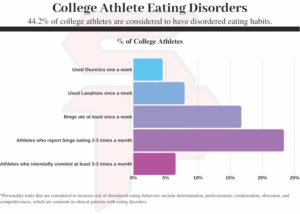 The degree of the obsession around thoughts and behaviors around food can differentiate disordered eating from an eating disorder. For all athletes, it is completely normal to think about food when hunger strikes or what one may have for their next meal.
For those battling with eating disorders, the considerations are commonly all-consuming. The athlete thinks about calories, taste, portion size, where to shop or eat and how they will feel following the meal. This degree of fixation can hinder focus at school and in sport, decrease the capacity to remain present, inhibit sleep and affect their ability to perform well.
While it’s hard to pass judgment on how much time and vitality a teammate is spending on food, it is the conscious effort to consistently engage in secretive behaviors that often produces the most validity.
Finally, the athlete’s level of performance is a distinguishing factor. When someone’s eating patterns take them away from classroom success, social interactions and sports performance, this can be a strong indication of an eating disorder. Female athletes, for example, may not go out with friends because of the fears around their judgment while she eats.
Other athletes might avoid work, school and team functions due to behaviors that yield a compulsion to exercise instead. While these examples may sound extreme, athletes who struggle often cite their ability to control something important in their life as the primary factor in partaking in negative behaviors. Ivy League athletes often have stated that among the demands of collegiate sports and academic rigors, the notion of controlling their own exercise and eating behaviors is empowering in a world where power has been removed.
The distinction between an eating disorder and disordered eating is one that takes observational practice in order to achieve understanding. Oftentimes, athletes who struggle with eating disorders report that their behavior began with disordered eating.
This by no means insinuates that all athletes who engage in disordered eating will have an eating disorder. Rather, it is a reminder to practice reflection and support for friends, teammates and family members whom you care deeply about.
If you have concerns about the nutritional well-being of a friend, I recommend you confide in your parents, your coach or a school official. If you see something, say something. Outside perspective is a great second set of eyes.
Joe Caligiuri (MS, ATC) is the owner of Stadium Performance in Dedham, Mass., and has served as athletic trainer for the NHL’s Los Angeles Kings and NFL’s New England Patriots. SP offers Boston’s No. 1 injury-prevention, ACL rehab and speed programming. Check out spstrengthcoach.com.